When a hydraulic cylinder starts leaking or losing performance, the rod is often the culprit. The polished steel shaft that extends and retracts on every cycle takes continuous abuse: seal contact, contamination, corrosion, impact, and the kind of relentless wear that comes with operating heavy equipment in demanding environments.
The question most maintenance managers face at that point is whether to repair the rod, replace the rod, or pursue a third path that most guides don’t mention: hydraulic cylinder rod remanufacturing. Getting that call right has a real impact on cost, downtime, and how long the fix actually holds.
Why the Rod Is Usually Where Failure Starts
A hydraulic cylinder has several components that can fail, but the rod is uniquely vulnerable. It’s the only part that cycles in and out of the cylinder on every stroke, which means it operates under constant sliding contact with the rod seals and wiper seals. Any surface damage on the rod destroys those seals quickly, and once seals start failing, fluid leaks out and contamination gets in.
The rod surface also has to maintain extremely tight tolerances to seal properly. Even minor pitting, scoring, or wear can create leak paths that no seal replacement will fix permanently. You can swap seals, but if the rod surface is compromised, you’re just managing symptoms.
Signs the Rod Is the Problem
Not every hydraulic cylinder failure traces back to the rod, but these are the indicators that point there first:
External Leaks at the Gland
Fluid weeping or dripping from the rod seal area is the most common early sign. If the rod surface is damaged, new seals won’t hold for long regardless of seal quality. Surface damage on the rod can also cut the seals, exacerbating the problem.
Visible Surface Damage
Scoring (linear scratches running along the rod from contaminated fluid), pitting (small craters from corrosion or cavitation), and stroke wear (a dull, worn band in the chrome at the seal contact zone after thousands of cycles).
Repeat Seal Failures
If the same cylinder keeps eating seals, the rod surface is almost certainly the root cause. Each new seal is running against the same damaged surface, and the outcome will be the same.
Bent Rod
Side loading, impact damage, or operating past rated capacity can bend the rod. A bent rod contacts the gland unevenly on every stroke, which accelerates seal wear and can damage the gland bore itself over time.
What “Re-Coating” Actually Gets You
In most hydraulic service contexts, repairing a cylinder rod means replacing the coating of the hard chrome or carbide coating. This works when the damage is truly superficial and the base material and chrome layer are still intact underneath.
The limitation is straightforward: once the damage goes deeper than what coating thicknesses can address within the maximum spec, you’re out of options on the coating path. You either accept a rod that’s undersized, or you move on to a more involved solution.
Re-coat is the right call when:
- Surface and base material damage is minor
- Coating thickness is not already at upper limits
- Rod is not already far under size
When Rod Replacement Makes Sense
Sometimes the rod is beyond restoration, or the economics of the situation favor replacement. Full cylinder replacement becomes the practical choice when:
- Repair or remanufacturing costs approach replacement cost on a low-value unit
- The rod is severely bent and straightening isn’t viable
- The rod is too small to allow for sufficient base material welding or coating thickness to be a viable repair path
For large-bore cylinders on haul trucks, excavators, or heavy industrial equipment, new OEM replacement rods carry significant price tags and can have long lead times. That’s where remanufacturing changes the math.
The Case for Engineered Rod Remanufacturing
Engineered remanufacturing is distinct from repair and from simple rebuilding. The process involves full inspection, base material dimensional restoration to OEM tolerances or better, and a coating application. For a rod with significant surface wear, the restoration process typically involves the followings:
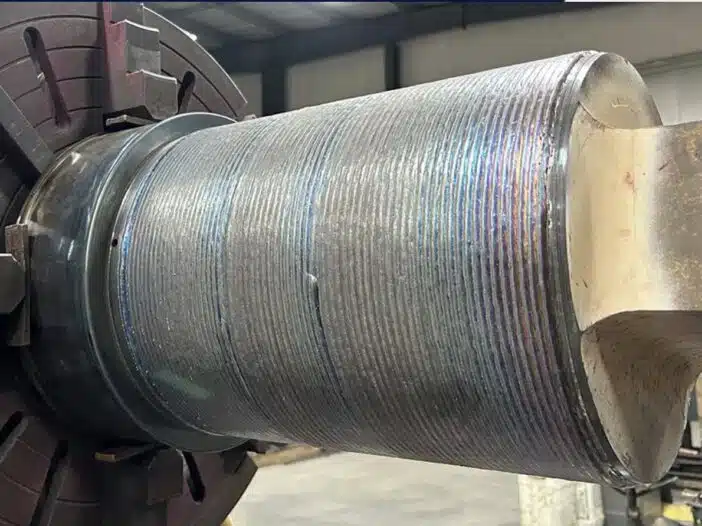
Weld Overlay
Where material loss is significant or damage goes deep, precision weld overlay rebuilds the affected area before machining back to tolerance. This handles cases where coatings alone are not sufficient to restore the rod geometry.
The result is a rod that meets or exceeds original dimensional and surface specifications, engineered to work with new seals and perform reliably in service. On high-value components, this typically costs 40% to 60% less than sourcing a new OEM cylinder while delivering comparable or better service life. After weld overlay, the original coating or an upgraded can be used to protect the newly restored substrate metal.
TIG / MIG / Welding Spot Repair
When base material damage is not widespread, it can often be repaired with welding, machining, grinding, and reapplication of a coating. Welding wire selection is critical to ensure proper coating bond, as well as minimize the risk of cracking at the weld site in service. For cylinder rods with moderate damage, this path has a long track record of performing well on hydraulic rods and delivers a like-new product at a lower cost than complete overlay.
How to Make the Call
When a rod comes in for evaluation, the decision generally follows this path:
| Rod Condition | Likely Best Path |
| Significant stroke wear or pitting | Re-coating |
| Corrosion deep into substrate | Weld overlay remanufacturing |
| Severely bent or cracked | Rod replacement or new cylinder |
| Repeat seal failures, surface worn | Re-coating or upgraded coating |
| Obsolete or discontinued part | Custom remanufacturing or replacement |
| Deep damage on large rod | Weld overlay remanufacturing |
The other variable worth factoring in is lead time. For critical production equipment or a machine mid-project, a remanufactured rod with a core on hand can often be turned around faster than a new OEM cylinder can be sourced and delivered.
What to Ask Before Sending a Rod Out
Not every shop that offers rod coatings operates at the same standard. For a high-value component, the questions worth asking include:
- What inspection is performed before work begins, and does it include checking for subsurface cracking?
- Which restoration process is being recommended, and why is it the right choice for this rod’s operating environment?
- What tolerances are held during final grinding, and how are they verified?
- What warranty covers the finished component?
A provider who answers those questions with specifics is operating at a different level than one who cleans, coats, and ships.
Frequently Asked Questions
How do I know if my hydraulic cylinder rod needs remanufacturing vs. a simple reseal?
If the rod surface shows visible wear, pitting, or scoring beyond superficial scratches, resealing alone won’t last. The seal is running against the damaged surface, and it will fail again. Remanufacturing addresses the surface before new seals go on. Polishing alone often covers underlying issues in the coating.
Can a bent hydraulic rod be saved?
Minor bends can sometimes be straightened with specialized equipment, but the rod must be inspected for subsurface stress cracking before returning to service. Severely bent rods are typically replaced rather than straightened.
How long does hydraulic rod remanufacturing take?
Turnaround depends on rod size and the restoration process required. In many cases, particularly when a core is on hand and coating capabilities are in-house, a remanufactured rod can be back faster than a new OEM replacement can be sourced.
What causes hydraulic rods to fail prematurely?
Contaminated fluid is the leading cause. Particles score the rod surface, which destroys seals, which allows more contamination into the system. Side loading, inadequate wiper seals, and operating in corrosive or high-humidity environments all accelerate wear. Addressing the root cause alongside the rod restoration prevents early re-failure.
Is remanufacturing a hydraulic rod better for the environment than buying new?
Yes. Remanufacturing consumes significantly less raw material and energy than producing a new component from scratch. For operations with sustainability commitments, this is a meaningful consideration alongside the cost and performance factors.