Surface wear is one of the biggest cost drivers in industrial operations. The coating process you choose determines how long your parts last, how often you’re down for replacements, and what you’re spending per operating hour. For decades, hard chrome plating and HVOF thermal spray have been the standard answers. HVAF (High Velocity Air-Fuel) is now outperforming both, and the data makes a compelling case.
What Makes HVAF Different
HVOF uses oxygen as the oxidizer, producing flame temperatures around 3,000 to 3,500 degrees C. At those temperatures, the tungsten carbide phase partially dissolves into the cobalt binder, a process called decarburization, which softens the coating and reduces wear resistance before it ever hits a part.
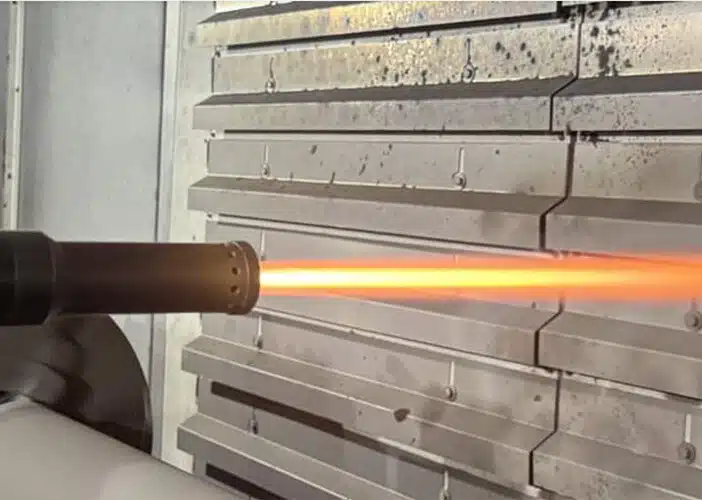
HVAF uses compressed air instead of oxygen. Flame temperatures drop by approximately 1,800 degrees F, but particle velocities are actually higher. Particles arrive at the substrate in a solid or semi-solid state: hot enough to bond, not hot enough to melt. The carbide microstructure is preserved intact.
The result is a harder, denser, better-bonded coating that also costs less to apply.
A Closer Look At The Numbers
| Property | HVAF (WC-CoCr) | HVOF (WC-Co) | Hard Chrome |
|---|---|---|---|
| Hardness (HV0.3) | 1,100 to 1,400 | 900 to 1,100 | 800 to 1,000 |
| Bond Strength | >10,000 psi | 8,000 to 10,000 psi | High; substrate-dependent |
| Porosity | <0.5% | 1 to 2% | 1 to 3% (micro-cracked) |
| Max Deposit Thickness | 0.040″+ | 0.020 to 0.030″ | 0.010 to 0.015″ |
| Substrate Temperature | <250 degrees F | 400 to 600 degrees F | ~130 degrees F (bath) |
| Cr6+ / F006 Hazardous Waste | None | None | Yes |
The hardness advantage over HVOF, typically 200 to 300 HV, comes directly from carbide preservation. In standardized ASTM G65 abrasion and ASTM G76 erosion testing, HVAF WC-CoCr coatings consistently show 30 to 50% less volume loss than HVOF WC-Co under equivalent conditions.
Porosity below 0.5% also gives HVAF a meaningful corrosion resistance advantage over both HVOF and hard chrome, which is inherently micro-cracked by the electrodeposition process.
Field Service Life
Lab data is one thing. Here is what shows up in production:
- Cold mill work rolls: HVAF WC-CoCr delivers 2 to 4 times the campaign life of hard chrome. Facilities transitioning from HVOF to HVAF report roll campaigns extending 40 to 60% longer before regrind.
- Corrugating, roofing, and industrial web rolls: Packaging and construction applications show similar step-change improvements over hard chrome, with replacement intervals extending from weeks to months.
- High-wear and high-corrosion hydraulic rods: Field data shows HVAF-coated rods matching or exceeding chrome service life while eliminating the hexavalent chromium waste stream entirely.
The Cost Case
HVAF is less expensive to apply than HVOF. The process uses compressed air instead of oxygen, achieves higher deposition efficiency, and requires less powder to lay down the same coating thickness. On a price-per-square-inch basis, HVAF typically runs 20 to 40% less than equivalent HVOF work.
Compared to hard chrome, HVAF carries a higher upfront coating cost; however, the total cost of ownership calculation changes the picture quickly. A simplified example for a roll application:
- Hard chrome: Lower coating cost, 6-month service life, plus Cr6+ disposal and compliance overhead
- HVAF: Higher coating cost, 18 to 24-month service life, typically at half the annual coating spend of chrome
Scale that across a fleet of rolls and the economics are decisive. Factor in avoided downtime as well; a roll change on a steel mill or paper machine can cost tens of thousands of dollars per hour in lost production, and coatings that double or triple service intervals eliminate shutdown events, not just coating dollars.
Hard chrome also carries regulatory costs that are only going up. Cr6+ is a regulated air pollutant under EPA NESHAP. Chrome plating baths generate F006 hazardous waste under RCRA. Forward-looking manufacturers are treating the transition away from chrome as supply chain risk management, not just a coating preference.
When HVAF Is the Right Call
HVAF is the right choice when wear life is the primary driver, when corrosion resistance matters, when substrate temperature is a constraint (HVOF’s 400 to 600 degree F heat load can distort precision parts), when you need deposit thickness beyond what HVOF can reliably deliver, or when you need to eliminate chrome regulatory exposure.
It is not a design change. Parts come in the same way and go out the same way; they just last significantly longer, at lower total cost.
Our HVAF Capability
High Tech Reman operates HVAF thermal spray at our Madisonville, Kentucky facility. We coat cylindrical components including industrial rolls, hydraulic rods, shafts, and spindles, as well as flat and irregular geometries. Standard material is WC-CoCr; Cr3C2-NiCr is available for elevated-temperature applications. We back HVAF with in-house hard chrome plating and weld overlay, providing weld, machine, coat, and grind capability under one roof.
We serve customers across North America with freight solutions for roll and shaft programs of all sizes.
Want to know if HVAF makes economic sense for your application? We will run the numbers with you. Contact us at (270) 825-4506 or [email protected]