In industrial maintenance, mining, and heavy manufacturing, coatings and remanufacturing are often used interchangeably. While they are related and frequently used together, they are not the same thing, and understanding the difference is critical when evaluating component life, reliability, and total cost of ownership.
Where Coatings and Remanufacturing Overlap
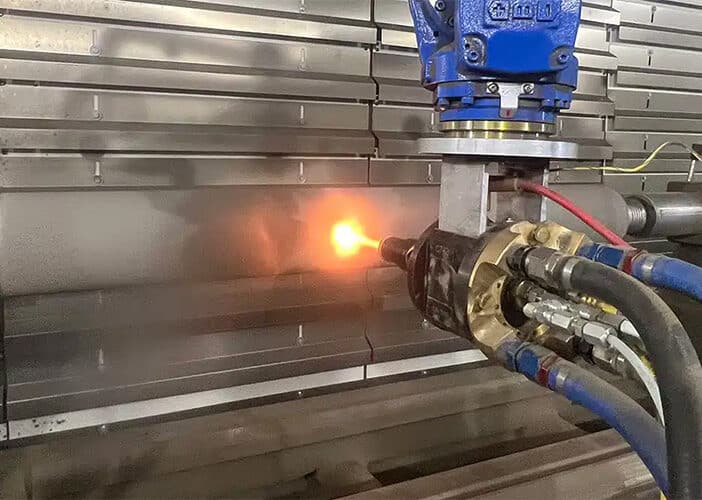
Coatings are an essential tool within many remanufacturing processes. Hard chrome plating, HVAF/HVOF carbide coatings, and other engineered surface treatments are commonly applied to restore wear resistance, corrosion protection, and surface finish.
In this context, coatings serve as a functional layer applied to a component that has already been properly prepared. When a part is dimensionally sound and structurally intact, a coating can restore performance and extend service life. This is where coatings and remanufacturing intersect.
For example, restoring a hydraulic rod that has experienced surface wear but retains proper geometry often involves stripping the old coating, correcting minor damage, applying a new coating, and finishing to specification. In these cases, coating is part of the remanufacturing solution.
When Coatings Alone Are Not Remanufacturing
Coatings are inherently surface-level solutions. They do not correct underlying issues such as dimensional loss, distortion, cracking, or base metal fatigue. Applying a coating to a component that has lost geometry or structural integrity may improve appearance but does not constitute true remanufacturing.
Common limitations of coatings when used alone include:
- Inability to restore significant dimensional loss
- No correction of distortion or misalignment
- No repair of cracks or fatigue damage
- Dependence on existing base metal integrity
- Limited structural load characteristics when used in thicker deposits
In these scenarios, coatings can mask problems rather than solve them, leading to premature failure, rework, or unplanned downtime.
What Defines True Remanufacturing
True remanufacturing begins below the surface. It addresses both the structural and dimensional condition of a component before any coating is applied.
A proper remanufacturing process may include:
- Weld overlay to rebuild lost material and restore geometry
- Controlled heat input to manage distortion and stress
- Precision machining and grinding to re-establish tolerances
- Non-destructive inspection to confirm base metal integrity
- Application of coatings only after structural restoration is complete
In this workflow, coatings are not the solution by themselves. They are the final layer applied to a component that has already been returned to a sound, dimensionally correct foundation.
When Coatings and Remanufacturing Are the Same
Coatings and remanufacturing align most closely when wear is limited to the surface, and the component remains structurally sound. In these cases, the remanufacturing effort may be primarily coating-focused, supported by inspection and finishing.
However, even in these situations, remanufacturing still involves defined procedures, inspection criteria, and quality controls that go beyond simply applying a coating.
Choosing the Right Approach
Understanding the difference between coatings and remanufacturing is essential when evaluating repair options. Coatings are powerful tools when applied correctly, but they are not a substitute for restoring geometry, structure, and metallurgical integrity.
At High Tech Reman, we integrate coatings into a broader engineered remanufacturing process. By addressing the base metal first and applying coatings as a finishing solution, we deliver repairs that restore performance, extend component life, and reduce total cost of ownership.
Not every component requires full remanufacturing, and not every coating application is insufficient. The key is knowing when each approach applies and ensuring the process matches the condition of the part.