
Mining components, rollers, shafts, and other industrial pieces face relentless wear. When it’s time to rebuild, the quality of the weld overlay makes the difference between long, reliable service and another premature shutdown.
We see this every day at High Tech Reman. Rollers, drive shafts, and other industrial components often arrive with failed overlays — work that looked fine on the surface but couldn’t handle real-world load and wear.
Common Overlay Failures We See
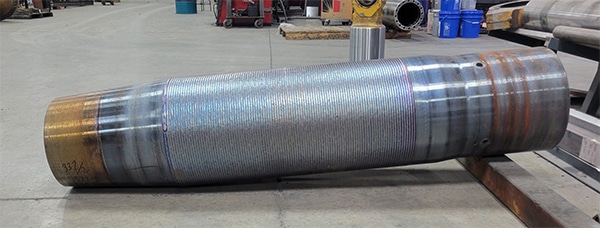
- Insufficient overlap: Gaps and valleys between passes that create thin spots and stress risers.
- Porosity & inclusions: Gas pockets or contamination trapped inside the weld, weakening the structure and compromising coating adhesion.
- Insufficient Mechanical Properties for the Application: Improper alloy selection and inconsistent procedures lead to premature wear and ultimate failure in heavy-duty environments.
- Cracking: Poor heat control and fusion leads to crack initiation that propagates into the Heat Affected Zone, resulting in ultimate failure.
These flaws shorten component life, increase failures, and lead to unexpected stoppages in critical production lines.
Our Approach: Engineered Overlay for Industrial Reliability
- Precision submerged arc welding (SAW): Consistent heat input and bead overlap to rebuild worn surfaces with structural integrity.
- Pre weld inspection & Machining: Dye Penetrant Testing, Magnetic Particle Inspection (MPI) ensuring a mechanically sound weld substrate.
- In-process quality control: A Consistent Process equals a consistent microstructure – which equals reliable, consistent performance. Macroscopic inspection, parameter tracking, and NDE where required for traceable, consistent results.
- Optimized finishes: Hard chrome or HVAF/HVOF coatings over a sound weld base for maximum wear and corrosion resistance.

Why It Matters
For mining and industrial operations, downtime is measured in lost tons, missed production, and real dollars. A poor overlay might seem cheaper up front but often fails early, requiring another repair cycle — and another production stop. A properly engineered overlay returns components to service stronger and longer-lasting than before.