
After more than a year of controlled development and qualification testing, High Tech Reman has successfully validated a precision remanufacturing process for haul truck bed hoist cylinder rods, covering Caterpillar 777–797 and Komatsu 830/930 platforms.
This engineered process replaces the need for full re-rod, while improving dimensional control, ROI, and consistency on safety-critical components.
Solving One of the Most Difficult Rod Repairs on the Truck
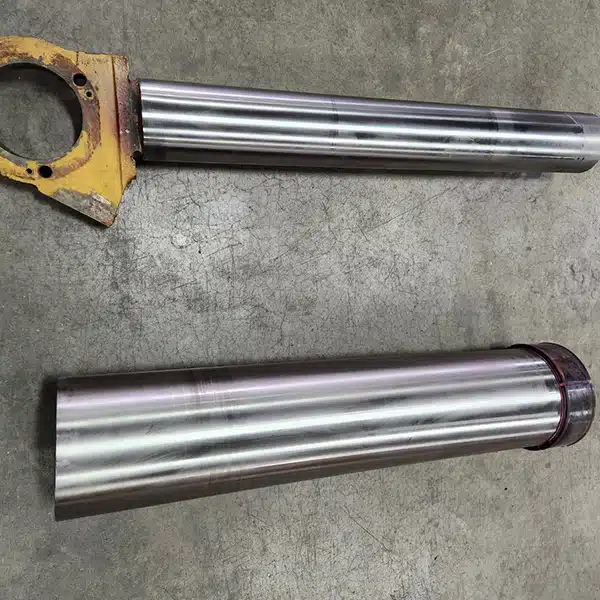
Caterpillar 793 hoist 1st and 2nd stage cylinder rods
Bed hoist rods are among the most demanding cylinder components in the field. Historically, damage in the eye area or out-of-spec coating thicknesses left fleets with two inefficient choices:
- Purchase a replacement rod
- Execute a full re-rod (typically 20+ labor hours)
Re-rodding these units introduces multiple challenges, including:
- Heat-input concentration at the eye weld joint
- Concentricity and straightness risk
- Increased cost
- Higher total cycle time and outage duration
The legacy path works, but it is slow, expensive, and unnecessarily risky when modern automation exists.
A Controlled, Repeatable, Alternative
High Tech Reman’s new process applies a precision-engineered weld overlay using:
- Robotic weld motion control
- Dynamic heat-input management
- Component-specific thermal ramping
- Low-distortion arc strategy
This results in:
- Stable geometry
- Consistent coating outcomes and performance
- Significant waste reduction
- Shorter turnaround vs. re-rodding
- Improved total cost of ownership for fleets
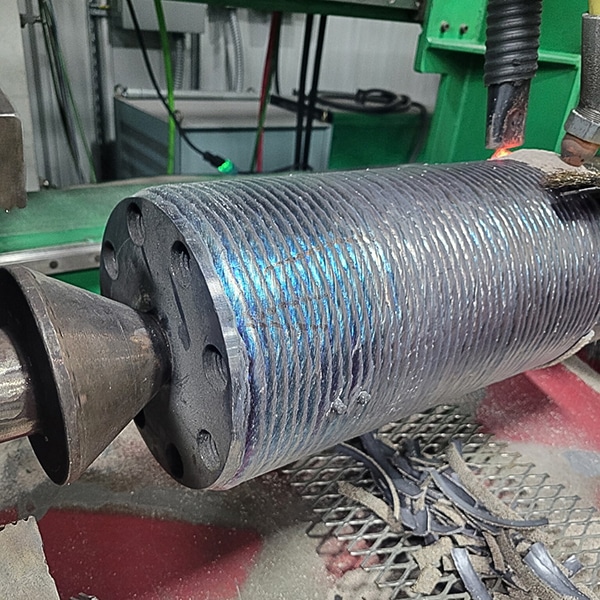
Weld overlay step on a 2nd stage hoist cylinder rod
Qualified Across the Most Demanding Platforms
This repair covers primary bed hoist rod stages on:
- Caterpillar 777–797 series
- Komatsu 830 and 930 series
Every unit is subjected to:
- Process traceability
- Dimensional validation
- Bore integrity checks
- Surface finish & hardness verification
All in alignment with High Tech Reman’s structured, data-driven remanufacturing standards.
A Modern Path for Heavy Equipment Remanufacturing
This new process represents a step forward in circular maintenance for mining fleets:
- Less unnecessary steel scrapped
- Higher rebuild reliability
- Lower downtime
- Reduced total life-cycle cost
It combines metallurgy, automation, and controlled welding science to extend the operating life of heavy equipment.