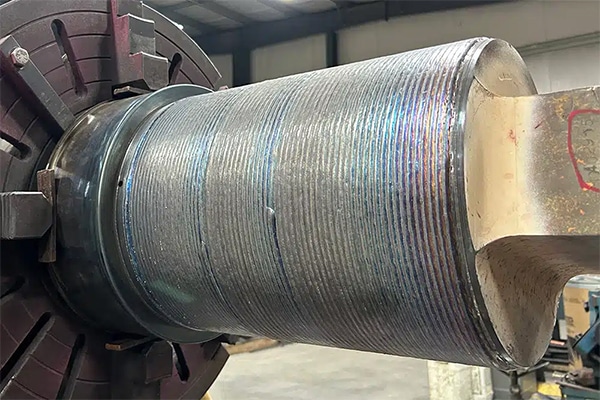
In heavy industry, weld overlay is a critical method for rebuilding and protecting components exposed to wear, corrosion, and high heat. Robotic welding has transformed this process by delivering consistent bead geometry, controlled dilution, and repeatable overlay thickness. The terms below outline the key language of engineered weld overlay and metallurgical bonding.
- Bead Geometry / Pitch is the shape, overlap, and spacing of each weld pass. Proper bead control eliminates valleys, produces smooth coverage, and ensures a uniform, defect-free surface.
- Dilution (Weld Overlay) refers to the amount of base metal that melts into the overlay during welding. Too much dilution weakens alloy chemistry, while controlled heat input and travel speed preserve the engineered properties of the overlay.
- Fusion Line is the metallurgical interface between the overlay and the base metal. A clean, continuous fusion line confirms complete bonding—not just material sitting on top.
- Porosity means gas pockets trapped within the weld. Clean part preparation, proper shielding gas, and optimized welding parameters help eliminate porosity and create a dense, solid deposit.
- Spalling is the flaking or chipping of a coating or overlay from the base metal. Proper surface prep, correct preheat, and controlled bead placement prevent separation and ensure long-term adhesion.
- Preheat involves heating the component before welding to reduce thermal shock, control hardness, and prevent cracking, especially on thick or high-strength materials.
- Interpass Temperature is the controlled temperature between individual weld passes. Keeping the part within a specified range prevents brittle microstructures and stabilizes the overlay.
- Heat Input represents the total energy delivered into the weld per unit length. Correct heat input avoids distortion, excessive dilution, and cracking, while improving metallurgical quality.
- Heat-Affected Zone (HAZ) is the region of base metal that does not melt but changes due to welding heat. Proper heat control protects the HAZ from becoming brittle or weakened.
- Heat Treating / Stress Relief is a controlled heating process performed after welding to remove internal stresses, stabilize the structure, and prevent cracking or distortion in service.
- Submerged Arc Welding (SAW) is a high-deposition welding process where the arc is shielded by flux. It produces clean, consistent overlays and is ideal for large surfaces and heavy industrial components.
- Robotic Welding uses automated positioning and programmed parameters to deliver consistent bead placement, uniform thickness, and repeatable quality without operator variability.
- Weld Overlay (SAW / MIG / TIG) is the application of engineered alloy layers onto a component to restore corrosion resistance, wear protection, or high-temperature performance. It is a metallurgical rebuild—not simply a surface patch.
- Weld Procedure Specification (WPS / PQR) documents the certified welding parameters such as heat input, preheat, filler alloy, and bead placement that ensure the overlay meets defined mechanical and metallurgical requirements.
Modern overlay work is a blend of metallurgy, automation, and precision heat control. By managing dilution, bead geometry, and residual stress, High Tech ReMan delivers engineered surfaces that outperform the original material and keep critical equipment running longer, safer, and more reliably.